We Don’t Have a Time Problem. We Have a Clarity Problem.
In leadership teams around the world, you hear a familiar explanation: “We simply don’t have time to work on strategy. We’re too busy.”
The more challenges an organization faces, the more often this becomes the narrative.
Yet in most cases, time is not the real constraint.
The deeper problem is a lack of clarity.
Organizations often try to do too many things at once. People work hard—sometimes extremely hard—but not necessarily on the things that will move the organization toward the future it wants to create.
The result is a peculiar organizational experience: everyone is busy, priorities are constantly shifting, meetings multiply, urgent issues consume the agenda—and yet progress feels frustratingly slow.
When everything becomes urgent
In perhaps 90 percent of cases, organizations are not actually too busy.
They lack a shared understanding of what matters most.
When people are unclear about where the organization is going and which actions matter most to getting there, they inevitably become reactive.
They respond to whatever is loudest, newest or most urgent.
A customer complaint takes precedence over a strategic initiative. A new competitor announcement changes the agenda. An internal problem becomes tomorrow’s emergency. A new opportunity appears and suddenly becomes a priority.
Over time, events begin to run the organization instead of goals.
The same dynamic applies beyond companies.
In geopolitics and society, those who are able to capture and redirect attention can exert disproportionate influence. Fragmented attention creates confusion. When people focus primarily on short-term emotions and immediate threats, long-term objectives become harder to pursue.
There is an old Estonian expression for this: peeing in your pants in winter. It creates warmth for a moment—but makes the situation considerably worse afterwards.
Organizations can fall into exactly the same trap.
Stop fighting fires. Start asking why they exist.
When a leadership team spends most of its time “putting out fires,” the obvious question is not simply how to put them out faster.
It is:
Why are there so many fires in the first place?
Often, the answer is not poor employees, difficult customers or an unusually turbulent market.
It is that the organization has failed to create a shared understanding of where it is going—and what matters most along the way.
When people do not know the priority, everything becomes a priority.
And when everything is a priority, nothing really is.
This is why organizational clarity is not a communication issue. It is a performance issue.
The connection between meaning and execution
There is a surprisingly strong parallel between what makes individuals feel fulfilled and what makes organizations perform.
People need to feel that they are moving toward something that matters.
Organizations need the same thing.
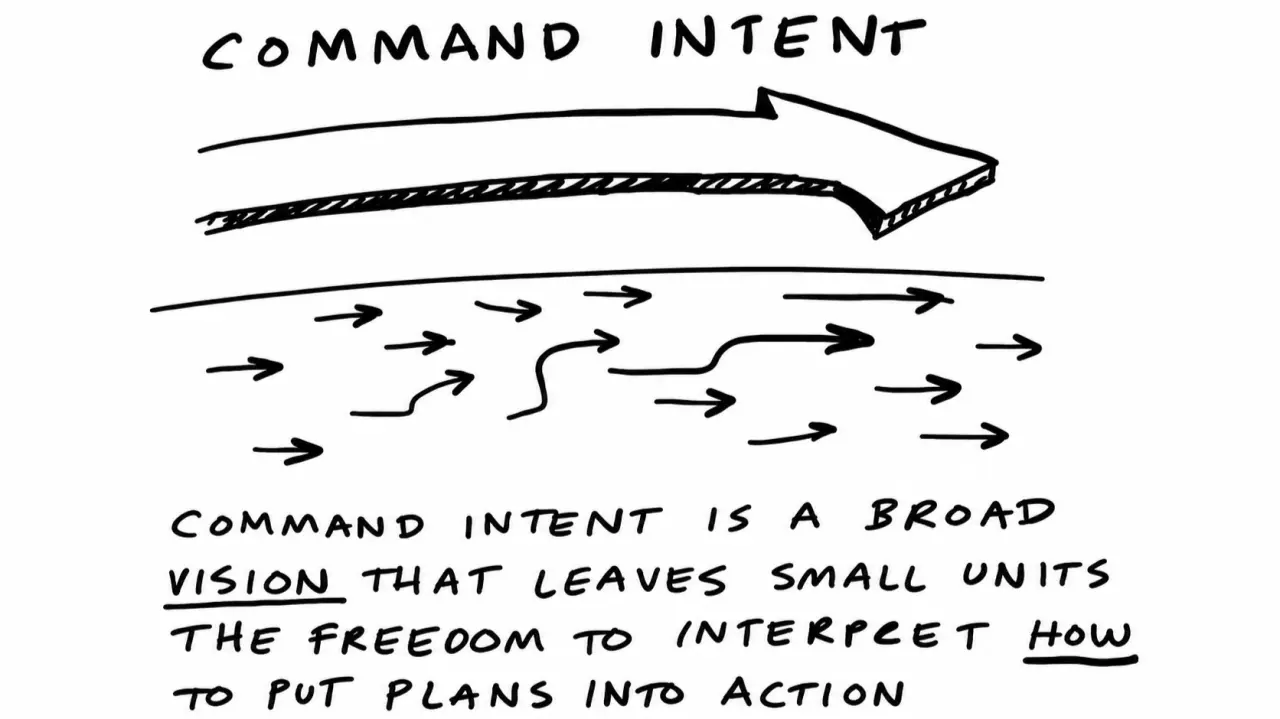
That requires a shared narrative—a clear vision and meaningful goals—that gives purpose to everyday work.
But vision alone is not enough.
The organization must also align its decisions, resources and activities with those goals.
In other words:
Direction + strategy + execution = organizational energy.
When these elements reinforce one another, people know why their work matters and what deserves their attention.
When they pull in different directions, frustration grows.
People can be working incredibly hard and still feel that they are getting nowhere.
Strategy is not prediction
Many leaders hesitate to engage deeply with strategy because the world feels increasingly unpredictable.
Artificial intelligence. Geopolitical instability. Energy prices. Technological disruption. Changing customer expectations.
How can you create a strategy when the future is impossible to predict?
But strategy has never been about predicting the future.
Strategy is about making choices.
It is deciding what game you are going to play, where you will play it and how you intend to win.
Everything beyond those choices is a process of learning and adaptation.
The winners are therefore not necessarily the organizations that predict the future most accurately.
They are the ones that learn fastest.
Five questions can create remarkable clarity
In Playing to Win, Roger Martin and A.G. Lafley describe strategy through five fundamental questions:
What is our winning aspiration?
Where will we play?
How will we win?
What capabilities must we build?
What management systems are required?
What is striking is that effective strategy does not require hundreds of slides or months of analysis before action begins.
The strongest strategic processes often start much more simply:
What is the critical problem preventing our growth—and what choices could address it?
The objective is not to create a perfect strategic document.
It is to create enough clarity for the organization to make better decisions.
That is why keeping the strategy on one page can be so powerful. It forces the leadership team to distinguish between what is essential and what is merely interesting.
The question behind the strategy
There is an even more important question that strong strategists ask:
“What must be true for this strategy to work?”
This changes the nature of strategic thinking.
Instead of trying to understand everything that could happen in the world, the leadership team focuses on the assumptions that actually determine whether the strategy will succeed.
Will customers value what we are offering?
Can we build the capabilities we need?
Will competitors respond in the way we expect?
Will our economics work at scale?
These are not questions that necessarily need perfect answers before action begins.
They are hypotheses to be tested.
And that is where real organizational speed begins.
Speed comes from learning, not working harder
Speed does not come from longer hours.
It does not come from more meetings.
And it certainly does not come from adding more initiatives to an already overloaded organization.
Speed comes from reducing uncertainty faster.
Amazon’s well-known Day 1 philosophy reflects a similar principle: many decisions should be made with imperfect information rather than delayed until certainty arrives.
If a decision turns out to be wrong, the organization adjusts.
The cost of being wrong is often manageable.
The cost of waiting too long can be much greater.
This creates an important distinction between two types of organizations:
One tries to make the perfect decision.
The other tries to make a good decision, learn quickly and adapt.
Over time, the second organization usually moves faster.
The performance advantage of learning
Research on organizational performance increasingly points in the same direction.
The strongest companies do not focus exclusively on short-term financial performance. They simultaneously build the capabilities that will allow them to perform in the future—including leadership capability, organizational learning and the ability to adapt.
That combination creates resilience.
It also creates growth.
And it makes organizations more attractive to the people they need to win.
Long-term performance does not come from reacting faster to every new problem.
It comes from building an organization that can learn faster than its environment changes—and faster than its competitors.
A better question for the next leadership meeting
So instead of asking:
“How can we get everything done?”
try asking:
“What would we stop doing if we were completely clear about what matters most?”
Then look at the calendar.
Which meetings consume time without moving a strategic priority forward?
Which projects exist largely because nobody has stopped them?
Which reports are still being produced because they always have been?
Which activities would disappear if the organization had absolute clarity about what it was trying to achieve?
These questions can create more value than another efficiency initiative.
Because in most organizations, the problem is not that people are not working hard enough.
They are.
The problem is that too much of that effort is being spent on things that matter less than they think.
The real source of organizational speed
Most organizations do not have a time problem.
They have a clarity problem.
When leadership creates genuine agreement about where the organization is going, what winning looks like and which few things matter most, something remarkable happens.
People start making different decisions.
Meetings become shorter.
Priorities become easier to defend.
Resources become easier to allocate.
And a surprising amount of “urgent” work simply disappears.
Clarity does not slow an organization down.
Clarity is what makes speed possible.