OKRs: The Bridge Between Strategy and Everyday Work
Strategy is ultimately a choice about how an organization intends to remain relevant.
Markets change.
Customer expectations change.
Technology changes.
Business models change.
The question is rarely whether change will come.
The more consequential question is whether the organization can recognize it early enough—and respond quickly enough.
That is where strategy meets execution.
And it is where many organizations struggle.
The Advantage of Adaptation
Nature offers an interesting perspective.
A living organism survives not because it remains unchanged, but because it continually adapts to its environment.
Organizations are not fundamentally different.
The word organization itself comes from the Greek organon—an instrument or system whose parts work together toward a purpose.
When those parts stop adapting, the system becomes increasingly disconnected from its environment.
The symptoms may initially be subtle.
Growth slows.
Margins begin to compress.
Customers behave differently.
New competitors appear.
The organization continues doing what made it successful in the first place.
Until it doesn't work anymore.
Nature Doesn't Wait for Annual Planning
David Attenborough's The Green Planet offers a fascinating illustration of this dynamic.
Plants and insects have been engaged in an extraordinarily long evolutionary arms race. Plants develop new chemical defenses, smells, colors and physical characteristics. Insects adapt in response. The plant changes again.
There is no annual strategy cycle.
No transformation program.
No steering committee.
Just continuous feedback and adaptation.
The broader principle is difficult to ignore.
Adaptation is not a project. It is a capability.
Organizations face the same reality, even if their mechanisms are different.
The Danger of Doing Everything Right
Some of the most instructive business failures are not caused by organizations doing obviously stupid things.
They are caused by successful organizations continuing to do yesterday's things extremely well.
Nokia is one example.
Kodak is another.
Both had significant technological capabilities. Both understood important aspects of where their industries were heading. Both had opportunities to shape what came next.
The problem was not necessarily a lack of intelligence.
It was the difficulty of moving resources, attention and organizational energy away from the existing business and toward what was emerging.
Success creates inertia.
The better the existing system works, the harder it can be to change it.
From Performance to Change
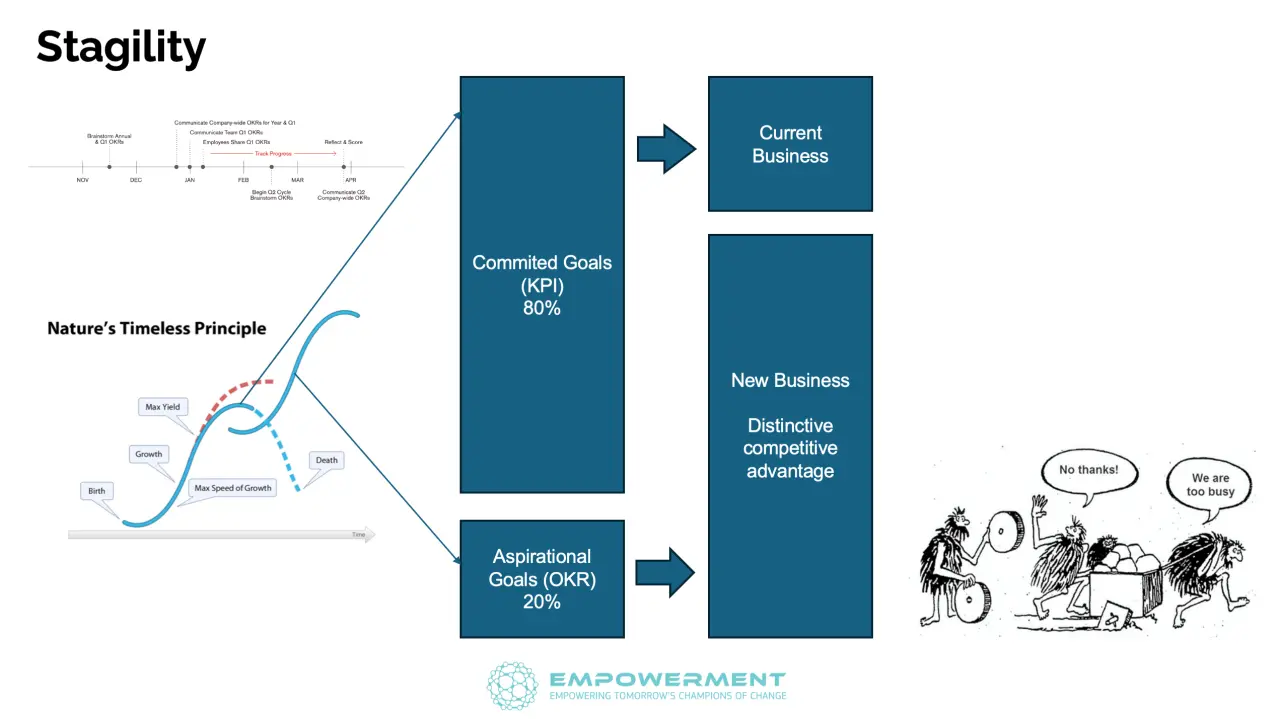
This is one reason the distinction between KPIs and OKRs matters.
KPIs generally describe the health and performance of the existing business.
Revenue.
Margin.
Customer retention.
Delivery performance.
Conversion.
They tell an organization whether the current machine is working.
OKRs serve a different purpose.
They create focus around what the organization is trying to change.
That distinction is important.
A KPI asks:
How are we performing?
An OKR asks:
What are we trying to make different?
The two systems complement each other.
One protects today's performance.
The other creates tomorrow's.
OKRs Are Not Really About Metrics
This is why reducing OKRs to a goal-setting framework misses the more interesting point.
The metric is only the visible part.
The real value lies in the conversation around it.
What are we trying to change?
Why does it matter?
What would need to become true?
What are we learning?
What is no longer working?
Where should we focus next?
A well-used OKR system creates a recurring conversation between strategy and reality.
The strategy provides direction.
Reality provides feedback.
The organization adjusts.
That is the bridge.
Strategy Cannot Stay at the Top
One of the recurring problems with strategy is that it often remains an executive-level concept.
The leadership team knows the priorities.
The organization knows its tasks.
The two are not necessarily connected.
People can be extremely busy while collectively moving in a direction nobody intended.
OKRs can help make that connection visible.
A strategic priority becomes something that teams can see in their own work.
Progress becomes discussable.
Trade-offs become explicit.
Dependencies emerge.
Problems surface earlier.
The organization gets a mechanism for repeatedly asking whether today's work is still connected to tomorrow's ambition.
The Weekly Rhythm Matters More Than the Quarterly Document
An OKR written at the beginning of a quarter does very little by itself.
Its value emerges through what happens afterwards.
A weekly conversation brings the objective back into view.
Progress creates information.
Information changes decisions.
Decisions change activity.
Activity creates new information.
The cycle continues.
This is why OKRs are ultimately less about goal-setting than about organizational rhythm.
The organization keeps returning to the same strategic direction while its understanding of the path evolves.
That creates something much more valuable than alignment at the beginning of a quarter.
It creates adaptive alignment.
Ambition Changes the Conversation
There is another reason OKRs can be powerful.
They can create room for ambitions that cannot be reached simply by asking people to work harder.
If the objective requires the same processes, the same assumptions and the same resource allocation, it may simply be an operational target.
A meaningful strategic objective often forces a different question:
What would have to change for this to become possible?
That question opens the door to new technology, new capabilities, different customer approaches, new partnerships or entirely different ways of working.
The objective becomes a reason to challenge the existing system.
The Culture Around the System Matters
No goal-setting framework can compensate for an organization that punishes transparency.
If people are afraid to report that an objective is off track, the numbers become theatre.
If teams optimize for their own targets rather than the company's priorities, alignment becomes an illusion.
If leadership changes priorities every few weeks, no framework will create focus.
The mechanics matter.
But the culture surrounding the mechanics matters more.
A useful OKR rhythm makes it safe to surface reality early.
Because the purpose is not to prove that the original plan was correct.
It is to discover what needs to change while there is still time to change it.
The Bridge Between Today and Tomorrow
This is where OKRs become more than a management framework.
They become a bridge between two worlds.
The operational world of today:
customers, revenue, deadlines, resources and existing commitments.
And the strategic world of tomorrow:
new capabilities, new markets, new products and competitive advantage.
The bridge only works when people cross it regularly.
That is why the rhythm matters.
Strategy is discussed.
Execution is reviewed.
Reality provides feedback.
Priorities evolve.
The organization learns.
Then the cycle begins again.
EMP365 — The Growth Operating System — is designed around this connection.
It brings strategic priorities, OKRs, commitments and execution into the weekly operating rhythm of leadership teams inside Microsoft 365 and Microsoft Teams.
Not as another reporting layer.
Not as another methodology to administer.
But as a way of keeping the relationship between strategy and everyday work visible.
Because strategy has little value if it remains above the organization.
And execution has little value if it is disconnected from where the organization is going.
**The real purpose of an OKR is not to measure the journey.
It is to keep the organization moving in the right direction while the destination itself continues to evolve.**