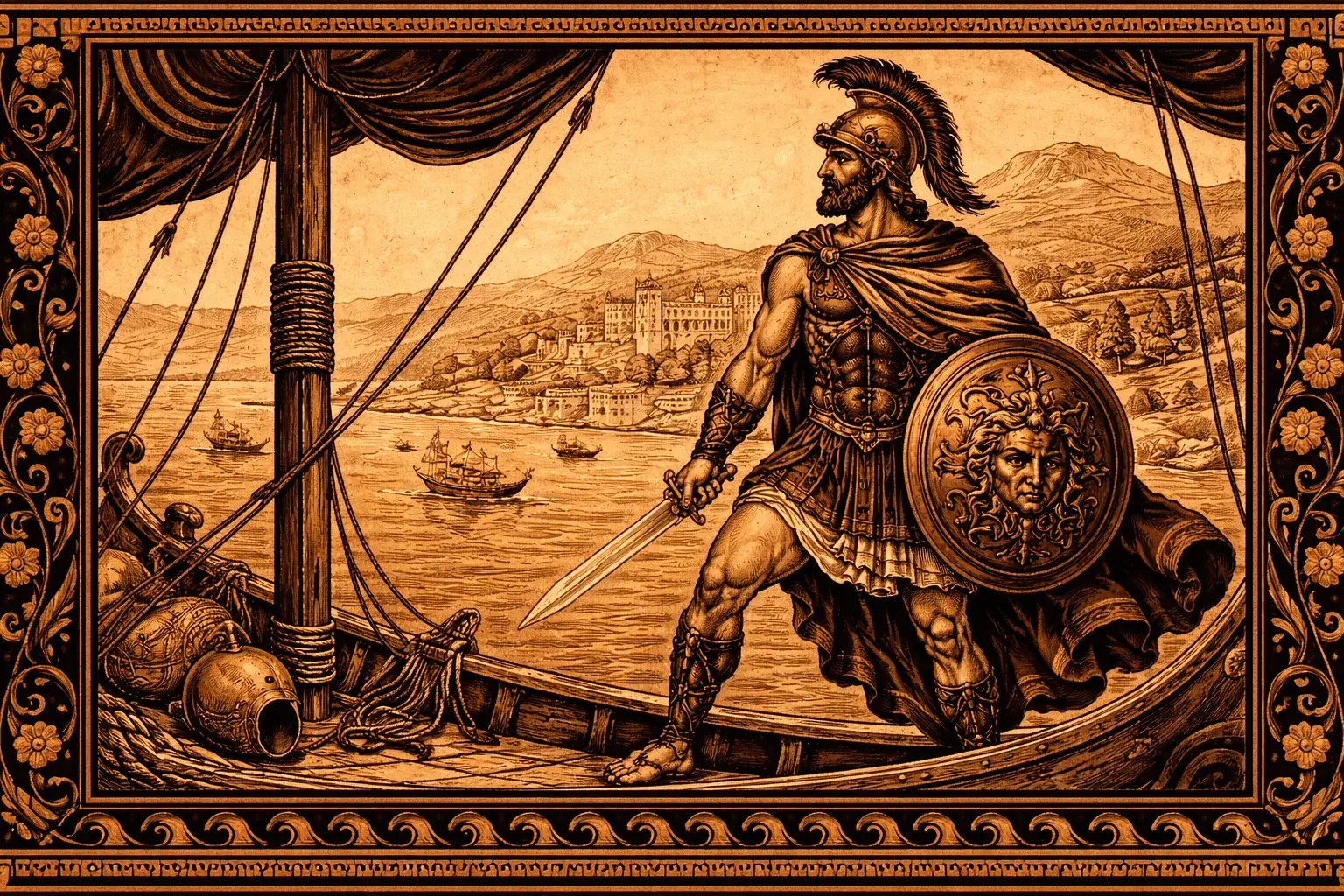
Odysseus: We Need People of the Sea
If you don't want to look at yourself, you need an enemy out there.
I like reading. I like going to exhibitions, concerts, theatre and the cinema. Every time, I know that someone is telling me a story — about their dreams, their struggles, their victories and their losses.
But as I've grown older, I've become less interested in simply looking at what is being shown and more interested in a different question:
Why was this story told in the first place?
I don't remember exactly where that habit came from. Perhaps it started when I was a teenager and the world felt much more closed than it does today. Books were one of the few ways to travel beyond the borders of your own experience.
Looking back, I realise that some of the people who shaped my understanding of the world were artists: Monet, Renoir, Degas, Van Gogh, Cézanne, Gauguin, Toulouse-Lautrec, Rodin and Gustav Klimt.
Quite a group to have raising a teenager.
We didn't live in today's media environment, where someone is constantly trying to change our opinion, provoke a reaction or sell us something. We discovered the world more slowly, through stories.
And perhaps that is where I picked up an idea that I still associate with Klimt's work:
Behind the visible and controlled version of ourselves, there is always another world.
That is why I rarely look at a painting only for the brushstrokes, or listen to music only for the beauty of the performance. With a film, I'm interested in more than what happens on the screen.
I want to understand what made someone tell this particular story.
What was happening inside them?
What were they running from?
What were they trying to reach?
With great creators, money is rarely the whole explanation. Something inside them makes the work necessary.
And so, when I encounter a great story, I tend to ask one simple question:
Why?
Why Odysseus? Why now?
That was the question I carried with me when I went to see Christopher Nolan's The Odyssey.
Why take a story that is almost 3,000 years old and tell it again now?
What is there in this ancient story that we still need to hear about ourselves in the 21st century?
On the surface, the answer seems straightforward.
Odysseus goes to war because the enemy is out there.
A different people. A different culture. Different beliefs and laws.
It is one of humanity's oldest and most politically convenient stories:
Us here. Them over there.
But the longer Odysseus's story continues, the less convincing that division becomes.
Troy is conquered not because the Greeks are morally superior to their enemies, but through deception. The Trojan Horse is an extraordinary strategic solution — the kind of thing that would probably win an innovation award today — but morally, the picture is much less comfortable.
And this is where the story becomes interesting.
In order to defeat the enemy, Odysseus begins to become something of the enemy he claims to be protecting his world from.
He speaks about the laws of the gods, yet violates them himself. He talks about order, while creating chaos and destruction. He fights for his values, yet becomes willing to abandon those same values in order to win.
And then the real journey begins.
The journey home
Troy has fallen.
The war has been won.
On a management consultant's slide, there would probably be a large green tick next to it:
Objective achieved.
Except Odysseus's problems are only beginning.
It takes another ten years to get home.
Storms. Cyclops. Sirens. Sorceresses. Monsters. The anger of the gods.
It can all be read as a spectacular sea adventure. But the longer the journey continues, the less geographical it becomes and the more internal it feels.
Odysseus's real problem is no longer how to navigate the sea and find Ithaca.
The question becomes:
How do you find your way back to yourself?
How do you become the person you were before winning became more important than the values you originally went to war for?
It takes ten years.
Along the way, Odysseus loses almost everything — his companions, his ships, his status, his power and eventually his sense of control.
Only when the external world has been stripped away does one uncomfortable question remain:
Who am I?
We like external enemies
This is where a nearly 3,000-year-old story suddenly becomes remarkably modern.
Because people — and organisations — have an extraordinary ability to find explanations for their problems somewhere else.
The more painful the problem, the more attractive the external explanation becomes.
The market isn't growing.
Competitors are cutting prices.
The economy is weak.
Regulation is getting in the way.
Head office doesn't understand.
The owners expect too much.
The employees have changed.
And the new generation is...
Well, the new generation is always a convenient suspect.
All of these problems can be completely real.
That is not the point.
The more interesting question is:
Why do we need them so badly?
Because as long as the problem is somewhere out there, we don't have to change ourselves.
If the market is to blame, we don't have to ask whether our value proposition has become weaker.
If employees are to blame, we don't have to ask what kind of organisation we have created as leaders.
If the competition is to blame, we don't have to ask whether we have stopped innovating.
If you don't want to look at yourself, you need an enemy out there.
The most dangerous moment comes after the victory
There is something particularly interesting about organisations.
Values rarely disappear during a major crisis.
In fact, that is usually when people talk about them the most.
Values disappear quietly through everyday compromises that seem perfectly rational at the time.
Competition forces us to compromise on quality.
Growth targets encourage us to sell customers something they don't really need.
Efficiency turns trust into control.
Process replaces judgement.
The long term gets traded for the quarter — naturally, only for this quarter.
None of these decisions seems fatal on its own.
Many of them can even look highly professional.
But eventually, we may discover that in trying to defeat the competition, we have become the kind of organisation we once entered the market to challenge.
That is the Odysseus paradox.
The most dangerous enemy is not the one that defeats you.
It is the one you are willing to become in order to win.
Ithaca and Day 1
This is where Homer's Ithaca meets Jeff Bezos's idea of Day 1.
Day 1 is not a date on the calendar. It is a mindset — an attempt to preserve the things that made an organisation alive in the first place.
Customer obsession.
Speed.
Curiosity.
The courage to make decisions.
Personal ownership.
A willingness to act rather than wait for someone else to solve the problem.
Day 2 begins when these things are gradually replaced by convenient substitutes: process, metrics, hierarchy, rules or some other mechanism that allows people to distance themselves from responsibility.
Bezos calls these proxies.
The process starts replacing the purpose.
The metric starts replacing reality.
The rule starts replacing judgement.
And the larger an organisation becomes, the easier it becomes for a leader to say:
“The system doesn't allow it.”
One of the protections of Day 1 is therefore a healthy scepticism towards these proxies.
Odysseus's Ithaca plays a similar role for me.
Getting home is not simply about returning to an island in the Mediterranean.
It is about returning to who you are, what you value and why you set out in the first place.
The hardest question for a leader
As leaders, we have become very good at asking what is happening in the market, what competitors are doing and which technology will disrupt our business next.
These are necessary questions.
But occasionally, there is another one worth asking.
And it is considerably more uncomfortable:
How much of the situation we are in today have we created ourselves?
Which principles have we quietly abandoned?
Which compromises have we justified by blaming the competition?
Which problems do we call external simply because doing so saves us from examining our own decisions and behaviour?
Maybe that is why The Odyssey has survived for almost 3,000 years.
It is not simply the story of a man trying to get home after a war.
It is the story of someone who, after conquering the world, has to find his way back to himself.
And perhaps the same is true for organisations.
Sometimes the next breakthrough does not require going further.
Sometimes it requires finding our way back to Ithaca.
--
The same principle applies to organisations.
Strategy does not create results by itself. It needs a rhythm of priorities, commitments, review and adjustment that brings people back to what matters — week after week.
EMP365 is the Growth Operating System that turns strategy into a repeatable execution rhythm for your leadership team.
Try EMP365 free for 30 days and see what changes when execution becomes a habit rather than another initiative.
Turn Your Leadership Team Into High-Performing Execution Champions.