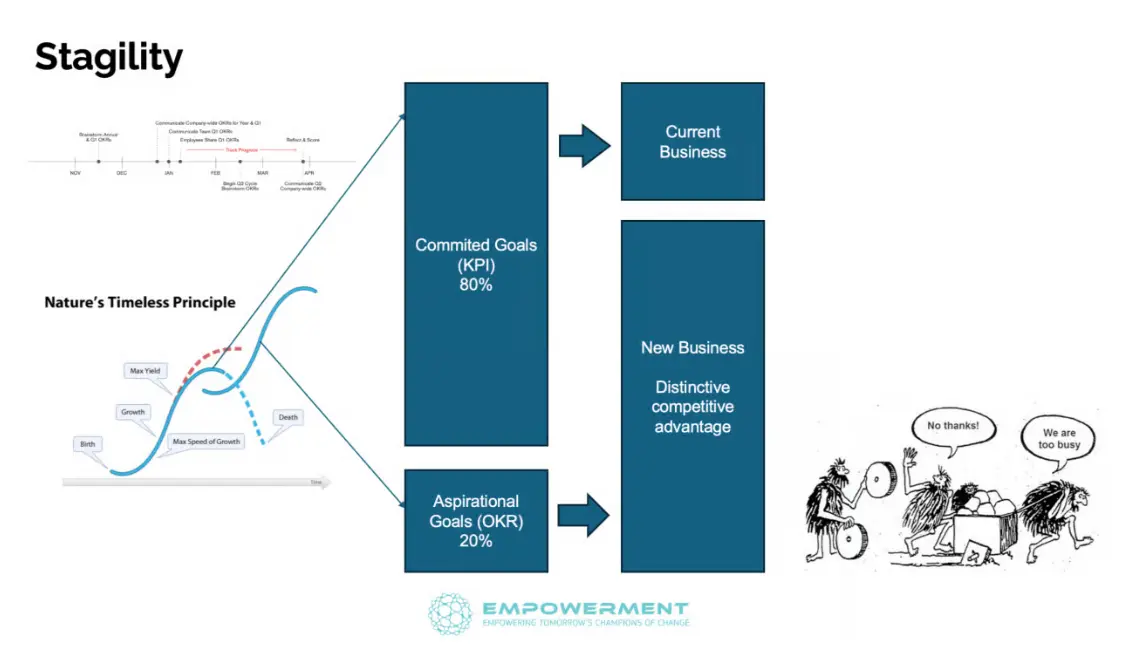
A New Operating System: Stagility
“The right to live belongs only to those who take an interest in life.”
— Emil Cioran
An organisation’s operating system—its management system—must be continuously updated. If it is not developed consciously, systematically and consistently, the organisation’s performance suffers, internal tensions increase and the user experience deteriorates.
How do the most successful technology companies keep their operating systems up to date—helping us perform better while also influencing our behaviour? What can you learn from them and apply within your own team?
We have all experienced our everyday technological tools—smartphones and computers—regularly reminding us that their operating systems need updating.
Those who take the time to look at what an update includes usually discover that it improves the device’s performance, strengthens integration between applications and fixes issues that could otherwise create security and technical risks, cause frustration and undermine the user experience.
An organisation’s “operating system” is its management system. In practice, this is simply organisational culture: the way people collaborate to achieve more together in pursuit of a shared goal than they could achieve individually.
If a leader does not shape organisational culture consciously, systematically and consistently, it will evolve on its own—usually in ways that do not reflect the leader’s expectations or values.
In the film The Matrix, the protagonist Neo is offered two choices: a red pill and a blue pill. If he takes the red pill, he discovers the painful truth that reality is far more complex and demands much more from him than he ever imagined.
If he chooses the blue pill, he returns to his former life, blissfully unaware of what is really happening.
After a moment of reflection, he takes the red pill—a choice that marks the beginning of an epic personal journey. Through a series of heroic acts, Neo eventually frees humanity from a prison it had created through its own dependence.
To ensure an organisation’s sustainable development, a leader has no choice but to take the “red pill” regularly. The leader must ask what needs to be improved in the organisation’s management system.
If demand for the organisation’s services is falling, profit margins are shrinking or the company is no longer considered an attractive employer, the root causes of these problems can usually be found in weaknesses within its operating—or management—system.
If demand and margins are declining, the organisation’s goal-setting process is not working effectively. A strong goal-setting process continuously monitors changes in the external environment and develops the capabilities required to strengthen competitiveness. Leaders at Nokia and Kodak have said that their companies lost their market-leading positions because they failed to notice important changes in the external environment—particularly in customer behaviour.
The development of competitiveness depends on organisational alignment: which roles and attitudes does the team need to build the capabilities required for the future? Because the external environment is constantly changing, a leader must regularly—at least once a quarter—ask the question posed by “trillion-dollar coach” Bill Campbell: “Do I have the right team for today’s game, and do I have the right people in the right roles?” If roles are unclear or occupied by the wrong people, tensions arise, performance declines significantly and the joy of working disappears.
Simply filling roles with the best individual players is not enough. Excellence emerges when the leader systematically and deliberately trains the team to play together. The organisation’s rate of development depends on how well its leadership team is trained. Team members will train their own teams only as effectively as their leader trains them (Reed Hastings, Netflix). Company culture is shaped from the top down—leadership is possible only through example.
The developers of the technological operating systems that support our daily lives—Microsoft, Apple and Google—do not leave improvement to chance. They continuously collect feedback and use processes that ensure it is acted upon quickly.
An annual customer survey—whether it measures satisfaction or engagement—is not enough to maintain competitiveness. Feedback should be gathered from the relevant people after every interaction.
Why not follow the same example? A leader’s “product” is their company.
The big news of 2024 is that the public sector has decided to become a driver of innovation.
The Government Office of Estonia launched a radical innovation programme for the civil service, asking senior public-sector leaders to take the “red pill” so that government institutions become more innovative—supported by the necessary structures, processes and people’s capabilities.
Through the radical innovation programme, senior leaders are expected to address the systemic challenges currently facing public administration, resulting in:
Greater progress by ministries and their areas of responsibility in developing and implementing innovative solutions;
Stronger cooperation between areas of government and the emergence of shared practices for developing and implementing innovative solutions;
Stronger innovation capabilities among senior civil servants, supporting smarter governance.
Considering today’s reality and the challenges facing Estonia’s public-sector leaders, the Government Office has chosen the right content and timing for the programme. These are precisely the questions the government must answer in order to provide citizens with better services more efficiently.
A forum has been created that should be capable of developing the necessary solutions and implementing them quickly.
However, in implementing the radical innovation programme, its organisers have chosen the blue pill.
The development programme has turned into a training programme whose objective is neither radical nor ambitious. The plan is to change the attitudes and mindsets of senior leaders by 2030.
The root cause is clearly stated in the programme’s technical procurement document:
“There is little point in investing more money in different innovation projects if the culture, structures and processes needed to sustain new initiatives are weak.”
— Mariana Mazzucato, Mission Economy: A Moonshot Guide to Changing Capitalism (2021)
So what has actually happened?
Public-sector leaders do not see the development programme as an effective instrument for solving the systemic and structural governance problems currently on the agenda. The programme is not integrated with the existing structures and systems of public administration.
The programme does not address real and urgent problems that have a significant impact on the efficient use of public funds. As a result, it is difficult to establish priorities or assess the effectiveness of the proposed solutions.
The team is trained by an external partner whose focus is on transferring knowledge and skills rather than solving important problems. New attitudes take root only when leaders demonstrate them through their own daily behaviour.
There is, however, another example of a new management system being introduced in the public sector.
Last year, the Government of the Republic of Estonia initiated a transformation process at Estonia’s largest company, Eesti Energia. A new leader is recruited when the owner’s expectations regarding the company’s development have changed.
When the game changes, it is entirely logical for the new leader to assemble a new team whose attitudes and capabilities are better aligned with the renewed vision.
The new management board has recognised that the existing operating system—Management by Objectives (MBO)—does not allow the organisation to respond to emerging market opportunities quickly or flexibly enough.
The process of installing a new operating system—Objectives and Key Results (OKRs)—has therefore begun, and a procurement process has been launched.
Eesti Energia needs a management system that enables the whole organisation to participate in and align around generating innovative ideas, supports cross-functional collaboration in implementing them, and ensures transparency and continuous learning through frequent feedback.
Both programmes aim to strengthen organisational competitiveness by improving efficiency through innovative solutions that change existing realities.
Eesti Energia’s management-system implementation programme differs from the Government Office’s development programme in several important ways:
The programme is sponsored by the company’s leader, who implements it through the leadership team. The leader trains the leadership team, whose members then become coaches for their own teams. Culture is shaped from the top down.
Employees acquire the necessary knowledge and skills independently. The required materials are freely available on the organisation’s intranet and connected to a learning environment that makes it possible to monitor the learning process and provide feedback. In the future, the same materials can be incorporated into the onboarding programme for new employees.
The implementation focuses on solving specific business problems, particularly through the goal-setting and execution process. Frequent planning and feedback give employees the confidence to experiment with new approaches and remove obstacles quickly.
The leader has set the objective of implementing the new management system within six months. Running several management systems in parallel is both expensive and confusing.
The programme involves four times as many people as the Government Office’s development programme, yet the result is expected to be achieved with three times less investment and eight times faster.
That is a genuinely radical and innovative approach—one that meets the essential criteria of achieving objectives many times faster and at a lower cost.
OKRs are widely used by leading technology companies to manage development and innovation. Their fundamental principles were formulated and first applied by Intel’s legendary leaders Andy Grove and Gordon Moore, and later developed further by John Doerr.
OKR implementation fails in 90% of cases because organisations violate the number-one rule of OKRs: OKRs are not used to manage a company’s daily operations. They are used to manage development and innovation.
Daily operations are managed through performance-management systems—KPIs—and the expectations defined for each role. During recruitment, these expectations provide a clear basis for evaluating a candidate’s suitability.
Role-specific performance expectations also help employees assess the quality of their own performance and define the developmental leap they must make over the next 90 days to achieve results faster, more cost-effectively and with less effort in the future.
That is the change managed through OKRs.
An objective is a developmental leap that helps the organisation achieve a meaningful and distinctive competitive advantage.
Key results are the measures used to assess, on a weekly basis, the level of confidence that the objective will be achieved. This insight then guides the next steps required to reach the objective faster and more effectively.
When OKRs are implemented, responsibility for daily results remains with the role owner—and the foundation for this is created through effective recruitment.
The leader’s focus is on developing team members and coaching the team to work effectively together. These are two essential responsibilities that people often push into the background amid the demands of daily work.
Kaarel Kotkas, CEO of Veriff, said in an Empowerment case study that the development of the team and its members must stay ahead of the organisation’s development because it is the organisation’s only true catalyst for growth.
Implementing OKRs makes it possible to create a balance between daily operations and development:
stability + agility = stagility.
An extensive study of Fortune 500 companies conducted by Rita Gunther McGrath, a professor at Columbia Business School, identified two defining characteristics of companies that achieve rapid and sustainable growth:
They are built around innovation, skilled at experimentation and able to respond quickly;
They are highly stable, with a consistent strategy and organisational structure, as well as a strong and enduring culture.
Organisations that combine stability and agility perform three times better than organisations that are agile but lack stable operational discipline—and more than four times better than organisations that are stable but lack agility.
Stability and agility are not opposites from which an organisation must choose. Both must be present and kept in balance.
That is stagility.